All Roles
Tips for Flu Prevention
Deck: How to protect yourself and our members from this virus
Deck:
How to protect yourself and our members from this virus
Story body part 1:
When flu season arrives, it’s important to stay well. As a matter of patient and workplace safety and professional pride, we can take steps to protect ourselves, our families, co-workers, and members and patients from flu and other infectious diseases. Here’s how.
Vaccinate yourself and others
- If you don’t get the flu, you won’t pass it on. The vaccine reduces the chance you will get the flu. Encourage others to get vaccinated, too.
Keep flu out of the air
- Limit the time patients with suspected flu spend in open waiting rooms; separate them from others.
- Offer surgical masks to people who are coughing or sneezing and encourage them to cover their coughs. Supply tissues, trash cans and hand sanitizer in waiting areas.
- Place patients with flu in a private room.
- Avoid unnecessary transport of infectious patients — and have them wear surgical masks outside their rooms.
Keep flu off of yourself. Follow standard and droplet precautions
- Wear eye protection, gown and gloves.
- Wear respiratory protection when in the room with the patient and until the air has cleared after the patient has left the room (about one hour), or if you are doing procedures that may aerosolize infectious particles.
- Wash your hands often. Use hand sanitizer or wash with soap and water before and after all patient care.
- Avoid touching your face, clothing or mask with your hands.
Keep the environment clean
- Focus cleaning on high-contact surfaces: door knobs, elevator buttons, reception desks, exam tables, pharmacy furniture.
TOOLS
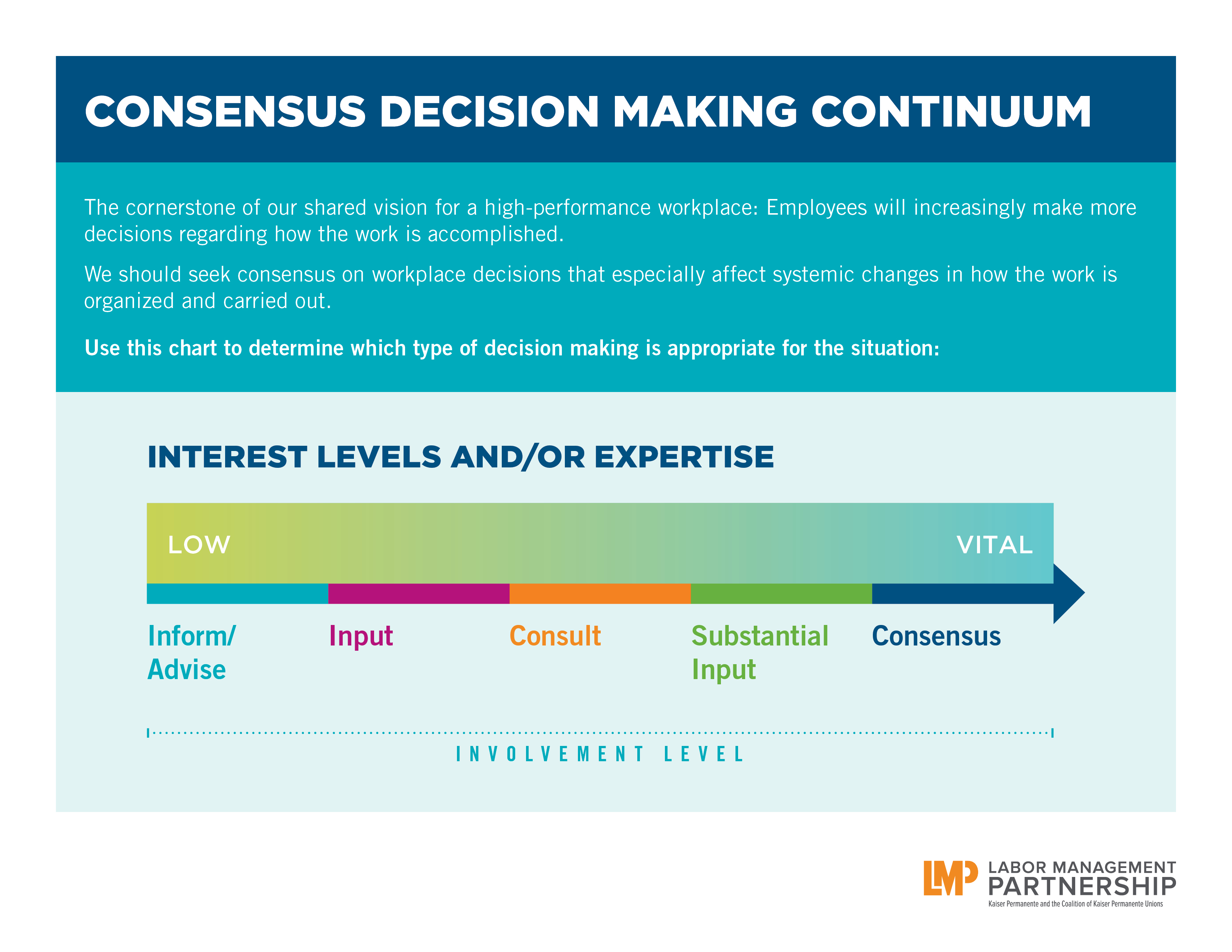
Consensus Decision Making Continuum
Format:
PDF and PPT slide
Size:
8.5" x 11"
Intended audience:
Leaders at any level who need to articulate what process will be used to make a decision.
Best used:
Hand out at meetings or use in presentations when discussing consensus decision making and interest based problem solving.
You may also be interested in Interest-Based Problem Solving: A Step-by-Step Guide
eStore
back to eStore

Hank Q1-2018
Navigate the future with this issue of Hank, dedicated to the workforce of the future!
Get tips and tools to ensure you get the skills needed to provide the best care and service — and make work more satisfying — in the years to come.
Minimum order: 25
eStore
back to eStore

Hank Q4-2017
Celebrate the 20th anniversary of the Labor Management Partnership. We are taking the high road, and there's no turning back!
Plus: Tips and tools for both rookie and veteran leaders of unit-based teams, as well as puzzles and games to mark our milestone.
You can also visit the Q4-2017 Hank web page in the Gallery section to read the issue online or download a PDF of it.
Minimum order: 25
TOOLS
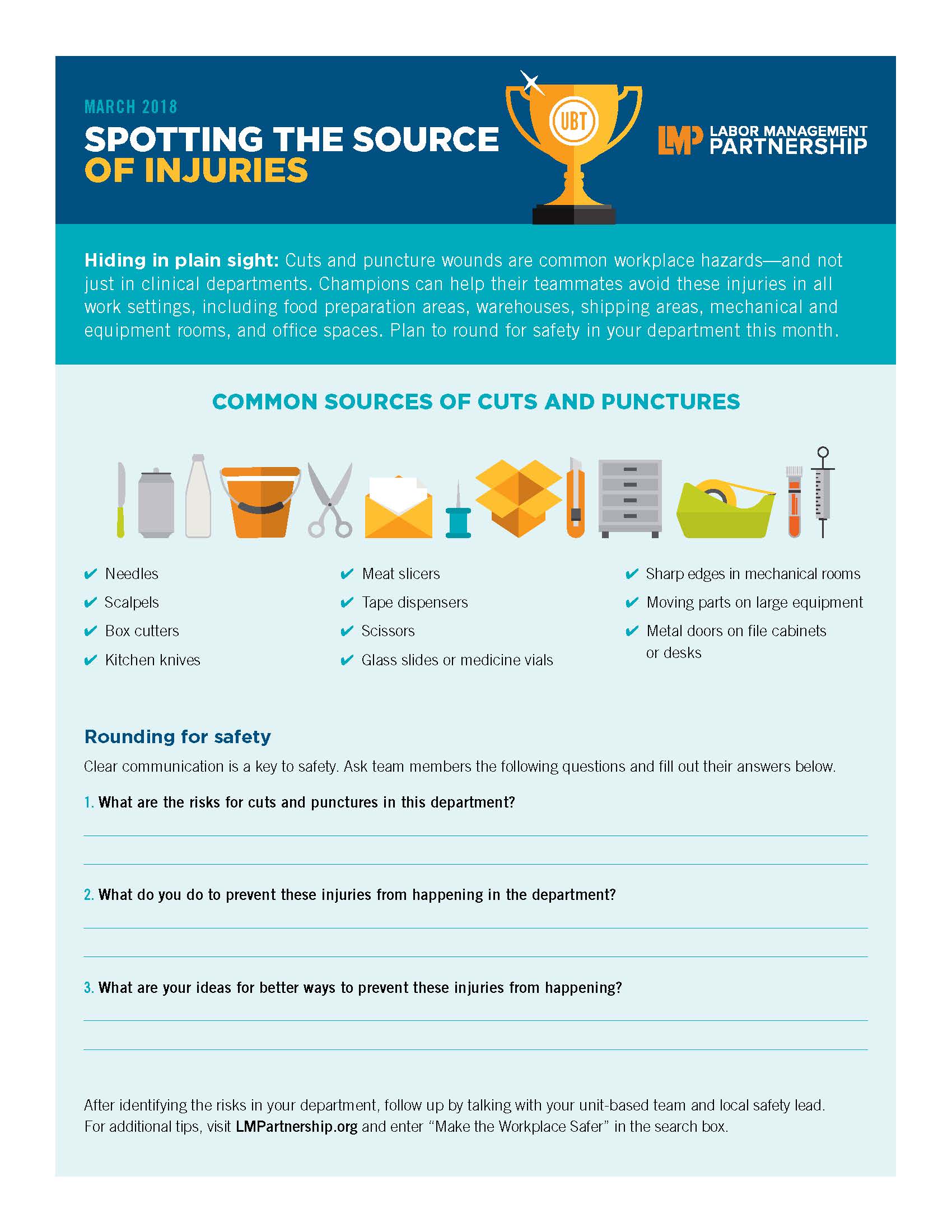
Health and Safety Champions—March 2018 Focus
Format:
PDF
Size:
8.5" x 11"
Intended audience:
UBT health and safety champions
Best used:
Use this tool to reduce the risk of cuts and puncture wounds in your team's workspace.
From the Desk of Henrietta: A Tale of Two Ankles
Story body part 1:
I have a friend who loves to play softball. In 1999, she tore her left Achilles tendon while sliding into first base. Her surgery involved getting cut open and then stitched up, which was painful and created a risk of infection. It put her in a heavy cast for six months, left a five-inch scar and was an all-around miserable experience.
Four years later, while playing racquetball, she (you guessed it) tore her right Achilles tendon. In just those few years, surgical technology had improved so much that she could get her leg patched up with laser surgery. She still had to wear a cast — but for only three months this time, and there was no scar. There was hardly any pain. “It was like night and day,” she says.
When someone says, “I don’t want to learn the new way. The old way works just fine,” I tell them about this friend.
Imagine that her doctor and care team had not bothered to learn about the laser surgery. Their patients would have suffered with a longer and tougher recovery than necessary. Caregivers want the best for their patients. That wouldn’t have been the best.
In everything we do, we put the patient and member at the center. Developing the skills of our workforce is no different. We learn new treatment methods to help our patients get better faster. We learn new software programs to help them get their medications more quickly and efficiently. We figure out the new technological gizmos so we can have virtual visits with our members, saving them the time, effort and sometimes discomfort of getting to our brick-and-mortar offices. We invent new ways of doing old jobs, or create entirely new jobs, to meet new needs.
Giving up the old way of doing things is scary, but also liberating. Learning new things can be difficult, but also fun. We’re navigating our way into the future together, supporting one another all along the way.
Deck: Kaiser Permanente and Coalition of KP Unions celebrate 20 years of partnership
Deck:
Kaiser Permanente and Coalition of KP Unions celebrate 20 years of partnership
Story body part 1:
Forty percent of U.S. marriages end in divorce after an average of eight years. Most business partnerships fail to meet expectations. And most campaigns end when they achieve their goals or the world moves on.
But the Labor Management Partnership between Kaiser Permanente and the Coalition of Kaiser Permanente Unions has beaten the odds: October 2017 marks the 20th anniversary of the partnership’s founding, making it by far the largest, longest-running and most sweeping such partnership in the country.
We’ve accomplished a lot together. And in a world of change, sustaining a healthy long-term relationship is an achievement in itself. A key to our success has been the willingess to honestly reflect on our successes, failures, and opportunities to improve.
By working in partnership, says Kaiser Permanente Chairman and CEO Bernard Tyson, “We have tapped into the potential of smart people all over the organization coming here every single day trying to figure out, ‘How do I improve quality, how do I improve service, how do I improve affordability?’ That’s an incredible competitive advantage for the organization.”
Marking a milestone
This fall Kaiser Permanente and the union coalition will be celebrating those achievements with special events and employee outreach. It won’t be all cake and balloons, however. LMP regional councils, unit-based team sponsors and co-leads, and others will host reflection sessions where workers, managers and physicians can share their experiences, pain points and suggestions for the future of partnership. Participants will consider three questions:
- What is different since we created partnership? (Or, what do you see as the top accomplishments of partnership?)
- What are the greatest challenges it faces today?
- How might we address those challenges, to strengthen partnership now and in the future?
Getting results
Partnership is not easy, and the parties don’t always agree on things. So what’s kept it going?
“It’s nice if we can all get along,” says Tyson. “But most important, we’re here to get results.” Here are some of the results achieved in partnership:
- Performance improvement: More than 50,000 team-led improvement projects since 2007, with measurable gains in quality, service, the work environment—and cost savings exceeding $48 million in 2016.
- Best place to work: Industry-leading wages and benefits, a voice in decision making, and an Employment and Income Security Agreement providing retraining and redeployment for displaced workers.
- Joint marketing: Strategic engagement brought strong gains in KP membership, union coalition membership, and more than $108 million in revenue for Kaiser Permanente in 2016.
- Job training and career advancement: More than 300,000 professional, academic and skill-enhancement courses taken by 104,000 coalition-represented employees since 2007.
- Systems collaboration: Joint implemention of multiple complex programs and systems, including KP HealthConnect, Claims Connect, ICD-10 and call center reorganization.
Lessons for success
All of the above have garnered attention from business, union and academic leaders over the years.
“The Labor Management Partnership is a shining example of how you bring labor and management together to produce results,” said Liz Shuler, secretary-treasurer of the AFL-CIO. “What I love about this model is the notion that, no matter where you work in the system, you have a place at the table and your voice is heard.”
Working in partnership also holds lessons that apply outside of work—including lessons that might have saved some of those failed marriages.
“If you are going to be a good partner and have a successful relationship, with a partner, kids, friends,” says a facilitator from 2015 national bargaining, “you have to have your partner’s needs in mind as well as your own.”
To learn more about LMP anniversary activities, visit the 20th Anniversary How-to Guide.
TOOLS
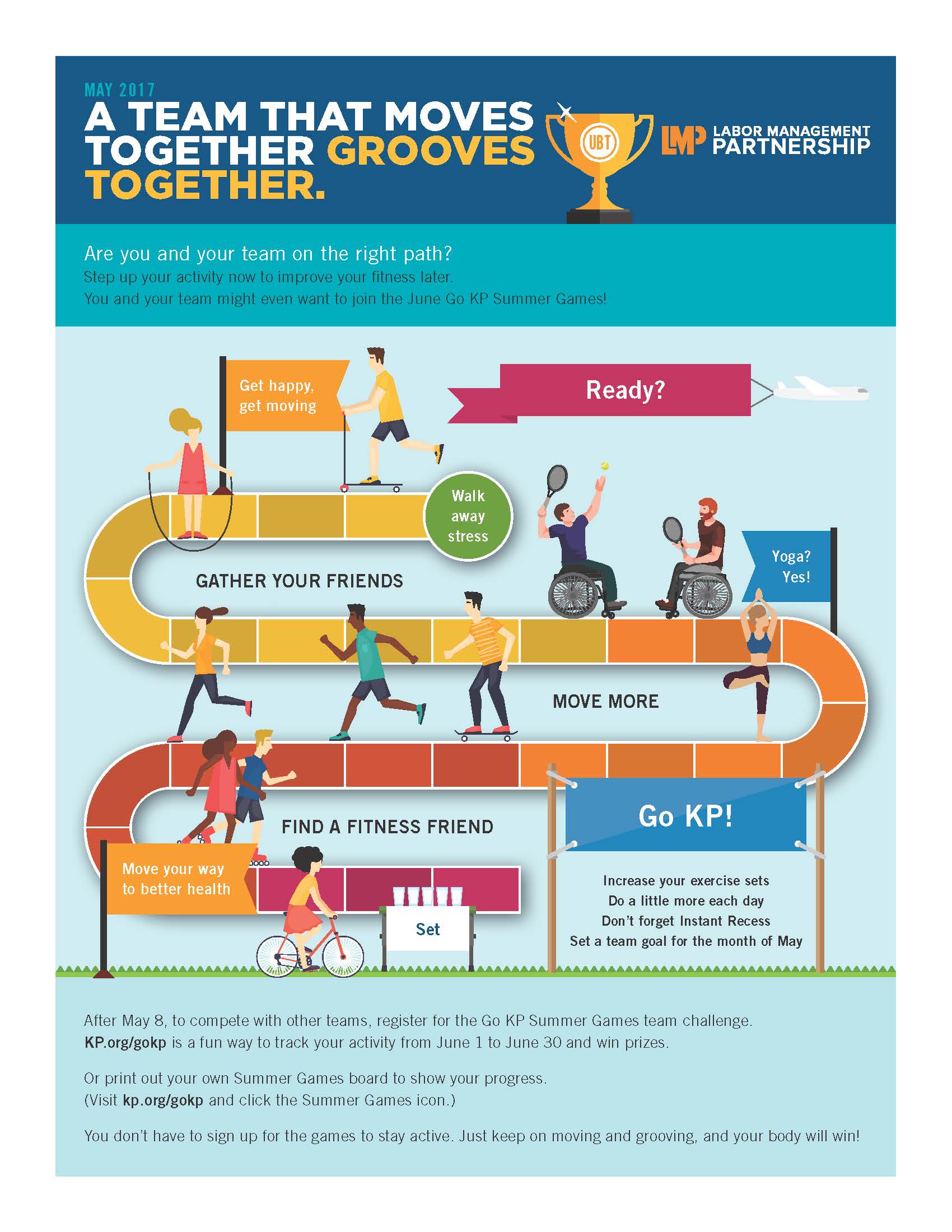
Health and Safety Champions—May 2017 Focus
Format:
PDF
Size:
One page, 8.5" x 11"
Intended audience:
UBT health and safety champions
Best used:
Use this flier to spark ideas and build participation in summer fitness activities.
TOOLS
Breakthrough Conversations
Format:
PDF
Size:
8.5" x 11"
Intended audience:
Unit-based team members, champions, consultants, union representatives, and management and labor leads working in partnership on a range of collaborative issues. This guide can help you escalate unresolved problems, build trust with colleagues, and improve your personal communications skills.
Best used:
Refer to this resource when you are preparing to give feedback and delve deeper into a difficult situation, or to prepare to respond to feedback or a request to discuss an issue.

Pages
