Kaiser Permanente and the Alliance of Health Care Unions

All Roles

New Book Spotlights Partnership Success

Deck: 
After 20 years, Labor Management Partnership still draws followers from health care and beyond

Story body part 1: 

When the leaders of Kaiser Permanente and the Coalition of Kaiser Permanente Unions shook hands on their Labor Management Partnership 20 years ago, they weren’t sure where it would take them. Today, it is the largest, longest-running partnership of its kind. It is also the most studied by university researchers.

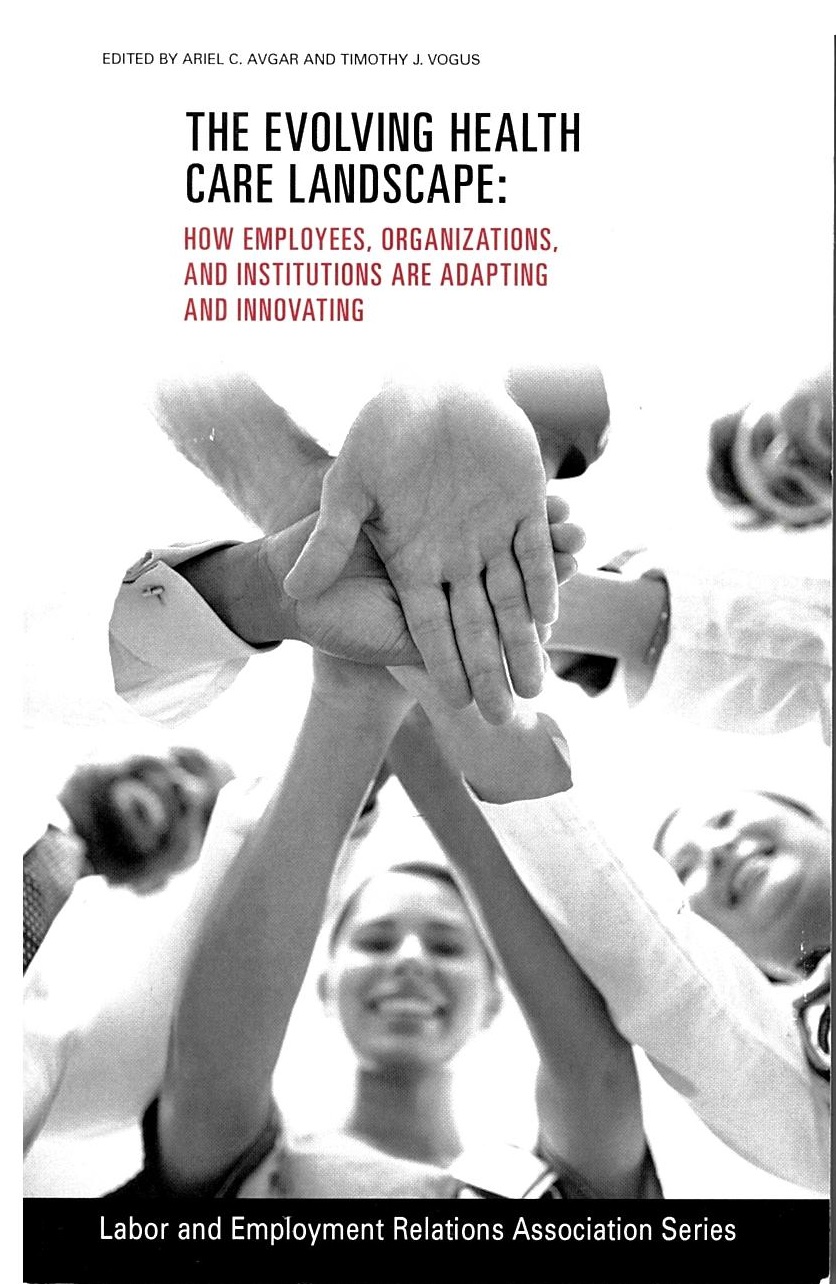
A new book published by the Labor and Employment Relations Association (LERA) and Cornell University Press shows that the partnership remains a model for workplace innovation. “The Evolving Healthcare Landscape: How Employees, Organizations, and Institutions are Adapting and Innovating” devotes three chapters to LMP’s history, accomplishments and challenges.

Lessons for others

Adrienne Eaton and Rebecca Givan, professors at Rutgers University, and Peter Lazes, a director and researcher at The City University of New York, studied six health care partnerships, including LMP. They were struck by:

“…the extent to which unions have been proactive in driving [all] these efforts....Another development in health care partnerships has been a significant deepening of the role of labor relations staff in operational matters.

“It is [also] important to note that the cases described here have influenced one another because the key stakeholders have directly learned from each other....[For example,] union and management stakeholders in Los Angeles [Department of Health Services and SEIU Local 721] as well as union leaders from the University of Vermont Medical Center have looked to Kaiser for answers.”

Another chapter, by Jody Gittell of Brandeis University and KP Northwest staff members Joan Resnick, Sarah Lax and Eliana Temkin, reports on regional efforts to promote collaboration across work teams. KP was selected for the study in part for what the authors call its “record of leadership and innovation [including] in patient care delivery, health information systems and labor-management relations.” Several strategies, including “living room huddles”—an informal, building-wide get-together—and job shadowing across departments led to higher employee engagement and patient satisfaction scores.

An inside look

The chapter “Leading Change Together” by Jim Pruitt, vice president of labor relations for the Permanente Federation, and Paul Cohen, LMP senior business consultant, explains the conditions that gave rise to the partnership, the need to implement it consistently across the organization and the way it achieves results:

“By bringing together diverse points of view and providing a framework for joint problem solving, the Labor Management Partnership has helped Kaiser Permanente tackle difficult issues....The partnership formed because conditions demanded change. It has endured because it has achieved measurable results. And it continues to flex and grow because we follow a few key principles and practices [including] self-directed work teams, interest-based problem solving and honest conversations.”

All of which explains why outside experts continue to take an interest in the joint efforts of KP and the union coalition. Pruitt and Cohen quote Thomas Kochan, a professor at MIT's Sloan School of Management, who put it this way in a 2013 study:

“Kaiser Permanente is now one of the nation’s leaders in the use of frontline teams to improve health care delivery....The Labor Management Partnership continues to serve…as a model for health care delivery and improvement.”
TOOLS

Leading Change Together

Format:
PDF

Size:
12 pages, 8.5" x 11"

Intended audience:
All workers, managers, physicians or others interested in the Labor Management Partnership

Best used:
This chapter from a Labor and Employment Relations Association (LERA) book on workforce innovation highlights the history and results of the Labor Management Partnership.

Related tools:

TOOLS

Unit-Based Teams Are Getting Results: 2017

Format:
PowerPoint

Size:
12 pages, 8.5" x 11"

Intended audience:
Unit-based team members, co-leads, sponsors and consultants; union and KP leaders

Best used: 
Share in presentations or team meetings to see successful practices from UBTs across Kaiser Permanente.

Related tools:

Publications

Kaiser Permanente and the Partnership unions believe people take pride in their contributions, care about their jobs and each other, want to be involved in decisions about their work and want to share in the success of their efforts.  Use the information here to get connected and stay connected. And read up on how others have endorsed the value of our approach. 

Around the Regions (Spring 2014)

Story body part 1: 

Colorado

The new Lone Tree Specialty Care Medical Office, a 25-acre campus, boasts outdoor patios, picturesque mountain views and a walkway around the perimeter of the building. The facility, which opened in December 2013, was awarded a LEED (Leadership in Energy and Environmental Design) Silver certification by the United States Green Building Council. Lone Tree, which is near a light rail line, used recycled materials, water-wise fixtures and shading devices for balancing solar heat to win the LEED designation. The facility has nearly 350 employees and 45 physicians to take care of the 3,000 ambulatory surgeries and 3,000 minor procedures expected per year.

Georgia

What happens when two nurses from two different high-performing UBTs transfer to the same brand-new Level 1 team? That team zooms to a Level 4 in only 10 months. Jane Baxter and Ingrid Baillie, both RNs, had been UBT co-leads at the Crescent and Cumberland medical centers, respectively, and then joined the Ob/Gyn staff at Alpharetta. Drawing on their experience—at different times, they each have been UFCW Local 1996 members and members of management—they helped their new UBT move up through the Path to Performance. “We knew the steps in the process and what to expect,” says Baxter. Their advice to fledging teams: Start with small performance improvement projects in areas that clearly are Kaiser Permanente priorities and that already have lots of data collected.

Hawaii

Nurses on the 1-West Medical-Surgical unit-based team at Moanalua Medical Center vastly improved how well they educate patients about medications, moving from about 40 percent of surveyed patients saying they understood side effects and other aspects of their prescriptions to 96 percent reporting this awareness. Between April and December 2013, the RNs, who are members of the Hawaii Nurses’ Association (HNA), made notations on patient room whiteboards, rounded hourly and did daily teach-backs on every shift. The team members designed a three-day survey for a sampling of patients to report what they understood about side effects of their medicine. The survey provided speedier feedback than waiting more than three months for HCAHPS (Hospital Consumer Assessment of Healthcare Providers and Systems) scores.

Mid-Atlantic States

A Nephrology team at Tysons Corner Medical Center in Virginia helped patients prevent or manage chronic kidney disease by getting them into the classroom. Just 70 percent of the unit’s patients at risk of renal failure were enrolling in KP disease management classes in February 2013. But several successful tests of change boosted at-risk patient enrollment in March to 100 percent, where it has remained since. The team noted on individual patient charts if the member suffered chronic kidney disease, developed scripting for in-person coaching, mailed class invitations to patients’ homes and handed out class agendas with after-visit summaries.

Northern California

The Modesto Pediatrics UBT improved wait times for immunizations—and not only increased service scores but also reduced overtime costs, an example of how a change can affect an entire system. The team reduced patient waits for immunizations from 45 minutes to 15 minutes between June and August 2013 and maintained the improvement through the rest of the year. A workflow change was key to the dramatic reduction. When a patient is ready for an injection, physicians now copy the orders to a nursing in-box instead of searching for a licensed vocational nurse to give the shot. The half-hour reduction in wait times—which is credited with improving service scores from 86 percent to 95 percent—also reduced the need for LVN overtime by an hour a day, resulting in savings of more than $16,600 over six months. 

Northwest

The regional Employee Health and Safety department won KP’s “Engaging the Frontline” National Workplace Safety Award. Through the Northwest’s Safety Committee Challenge, facilities had to complete a rigorous set of tasks, including regularly scheduled safety meetings, joint planning with NW Permanente and Permanente Dental Associates, safety conversation training, awareness plans and a safety promotion event during the year. Of the 16 facilities that rose to the challenge, nine met all of the qualifications. The region ended the year with a 4 percent reduction in accepted claims compared with 2013. Leonard Hayes, regional EVS manager, won the individual award for his work, which contributed to the East service area’s EVS team going injury-free for the last four years.

Southern California

The regional LMP council has set a 2014 Performance Sharing Program (PSP) goal to power up unit-based teams’ achievements on improving affordability. When at least 50 percent of a medical center’s UBTs complete a project that saves money or improves revenue capture—and if the region meets its financial goals—eligible employees and managers there will get a boost in their bonus. “Imagine how powerful it will be to have a majority of unit-based teams achieving measurable cost-savings and revenue-capture improvements,” says Josh Rutkoff, a national coordinator for the Coalition of Kaiser Permanente Unions. “The idea is to take all the strong work on affordability at the front line to a whole new level.”

From the Desk of Henrietta: O Is for Ostrich

Story body part 1: 

Take, if you will, the humble cell phone.

Oh wait. The cell phone may be ubiquitous, but it’s far from humble. Today’s smarty-pants phones have more power than the computers on the Voyager 1, which was launched in 1977 and 36 years later departed our solar system. Its three computers can process about 8,000 instructions per second. A smartphone swallows more than 14 billion.

The articles in this issue of Hank—articles about how technology is transforming care delivery and about how individuals and Kaiser Permanente are meeting the challenges that presents—would have overwhelmed the Voyager computers’ memory.

For communicating across distances, the string with two tin cans is humble. Even the rotary phone, patented in 1892, seems modest in comparison with today’s devices, which are used more for all manner of modern information sharing than for something as quaint as talking to another human being.

A rapid tech-based transformation, akin to the makeover of the old-fashioned phone, is already sweeping through care delivery. It’s hard to fathom the many ways technology will allow us to decentralize the delivery of health care while improving our connection with our patients and members. The changes will require new skills.

And starting today, the mindset we bring to the workplace is just as important as our skills. Without a willingness to explore new ways of doing our work, we are (to mix a metaphor) like an ostrich dialing the operator for help on a rotary phone, patiently waiting the long seconds for the 0 to return to its starting place while the future creeps up from behind. We’ll never know what got us.

Be bold. Be willing to go where no one has gone before.

TOOLS

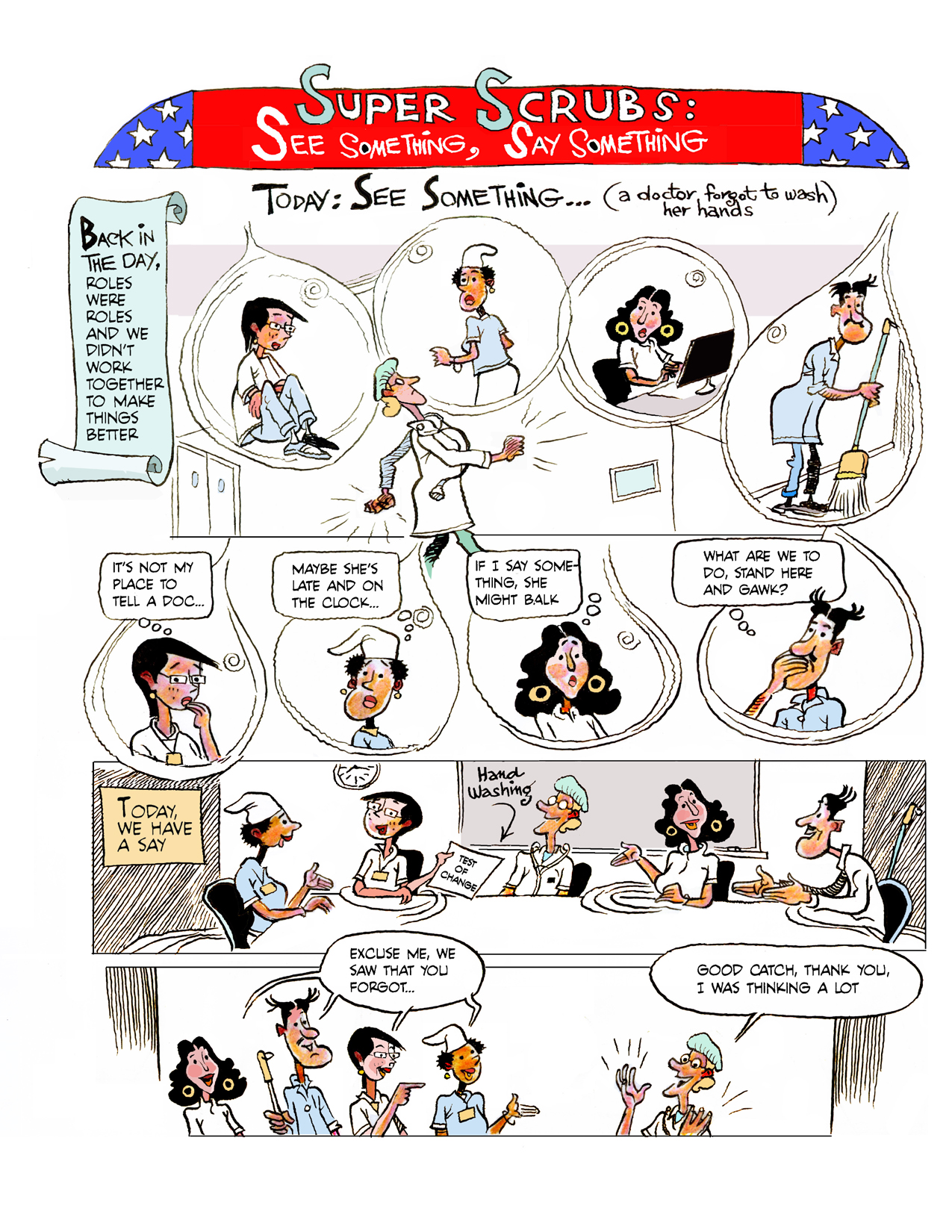
SuperScrubs: See Something, Say Something

Format:
PDF (color or black and white)

Size:
8.5" x 11"

Intended audience:
Anyone with a sense of humor

Best used:
In this full-page comic, our superheroes share how speaking up can keep your work environment—and our patients—safe.

Related tools:

Hair on Fire? There's Hope

Deck: 
Stress and health care work seem to go hand in hand. Here are ways to fix the problem.

Story body part 1: 

Struggling with stress? Got the burnout blues? We’ve all been there. A long line of patients snaking out the pharmacy door; appointments running a half-hour late.

Yet not all things that trigger stress are bad—getting excited before running a race is stressful; so is falling in love.

“A little bit of stress is good,” says Dawn Clark, MD, an ob-gyn specialist and chief facilitator of physician wellness for the Southern California Permanente Medical Group. “It helps you avoid boredom and keeps you engaged and energetic. But too much stress burns you out.”

Unfortunately, the chronic stress that leads to burnout is commonplace in health care. A 2013 survey found nearly 60 percent of health care providers are burned out. A 2015 nationwide poll showed burnout affects nearly half of all physicians.

The result? A burned-out workforce is one with low morale and high rates of absenteeism, turnover and workplace injuries. Inevitably, service and quality of care slip.

This issue of Hank takes a look at the causes of health care stress and burnout—and at the solutions. Read on to find out more about how:

  • Individuals can take steps to handle stress better.
  • Leaders can be role models and make solving workplace stress a priority.
  • Unit-based teams can address the root causes of burnout, finding remedies for lasting change.

Burnout: A widespread problem

Stress is the brain’s response to the demands put on us. Your pulse quickens, your muscles tense and you breathe faster. Everyday stresses are like small flames keeping you on alert. Burnout—which sets in when stress and frustration pile up without getting fixed—is your own personal forest fire.

Your body wears down as the constant flow of stress hormones suppresses your immune system and other functions. You don’t sleep well, and you become edgy, irritable and cynical. You don’t make good decisions. In short, you shut down. Making matters worse, your black cloud is contagious and can quickly spread to your co-workers.

Experts say burnout is usually caused by:

  • inefficient work procedures—and no power to change them
  • no sense of meaning and purpose to your workday
  • lack of work-life balance

In health care, the problem is even more complex. Frontline employees are expected to be selfless and put others’ needs first. But patients may be unhappy or demand answers when there are no easy answers to give. That’s stressful, and even more so when busy schedules are factored in.

UBTs to the rescue

Poorly designed jobs and systems are a leading cause of burnout, which means UBTs have amazing power to improve matters.

Say, for example, overlapping processes make a member-patient feel like she’s getting tossed from department to department. Her justifiable frustration may get unleashed on employees. A UBT provides a forum where an employee can speak up and say: “This process needs to change. What can we do to make the system smoother for the patient?”

That’s what Michael Leiter, an expert on workplace stress, says has to happen to reduce burnout. To fix it, you need to “change something that really matters about how you participate in your job.”

Sometimes the solutions are relatively simple. For members of the Esoteric UBT in the Sherman Way Central Lab in Southern California, working in cold, noisy room that made it hard to concentrate was causing stress—but they worked together and were able to move a key piece of equipment to a more comfortable room.

“Now at the end of the day, it doesn’t feel like I’ve just finished climbing a mountain,” says Gene Usher, one of the team’s research scientists. “It was a UBT success.”

Working together on performance improvement can cure what ails a team, as the Revenue Cycle team at Roseville Medical Center near Sacramento discovered. It also learned—as many teams do—that before it could fix its processes, it had to clear up underlying tensions first.

The team had low People Pulse scores; old conflicts between co-workers had never been resolved. So the team chose to improve its response to the survey question about “having a say in influencing decisions.”

“We decided to do tests of change that involved the staff more,” says management co-lead and former UBT consultant Kimberly Jones.

Team members started working together on improving the annual vacation process—a big morale boost. The 37-member team also took customer service trainings and a Kaiser Permanente Courageous Conversations class, which teaches different ways of approaching conflict and taking responsibility for your actions.

The class “made it easier to approach someone if there was a work problem,” says Stacey Kearny, an admitting representative and SEIU-UHW shop steward. “Now we act more like a team. When we come onto our shift, we ask the person leaving, ‘Is there something I can help you get finished?’”

From Tears to Cheers

Deck: 
Pharmacy UBT pulls through with good communication and widespread involvement

Story body part 1: 

Fairy Mills, a pharmacy technician and member of UFCW Local 555, has worked for Kaiser Permanente for 29 years. Not long ago, however, there were days she left the Mt. Scott Pharmacy ready to cry, exhausted. Wait times were up and service scores had plummeted. She thought about retiring but decided to tough it out—and was voted in as the union co-lead for the department’s unit-based team.

About the same time, Linh Chau arrived as the new supervisor. He wasn’t sure what he’d stepped into. “It was the perfect storm,” he says. “The team was stressed out, members were unhappy, membership was up, and in the midst of it all, we were implementing a new software system.”

Pharmacies in the Northwest region were in a tough spot a year or so ago—and that was especially true for the Mt. Scott Pharmacy. Part of the Sunnyside campus, it’s the second busiest pharmacy in the region, seeing an average of 500 patients a day and filling nearly 1,000 prescriptions.

Although other regions had already made the transition to ePIMS, a software system that syncs up with KP HealthConnect®, the migration process hadn’t been easy.

“We had to reenergize the team,” Chau says.

Chau and Mills’ first strategy was to give staff members confidence that things would improve. The two co-leads began rounding, checking in with UBT members regularly and making sure everyone had a chance to offer suggestions for improvement— giving them the power to shape how things are done, one of the key elements for beating back burnout.

Pages

Subscribe to RSS - All Roles