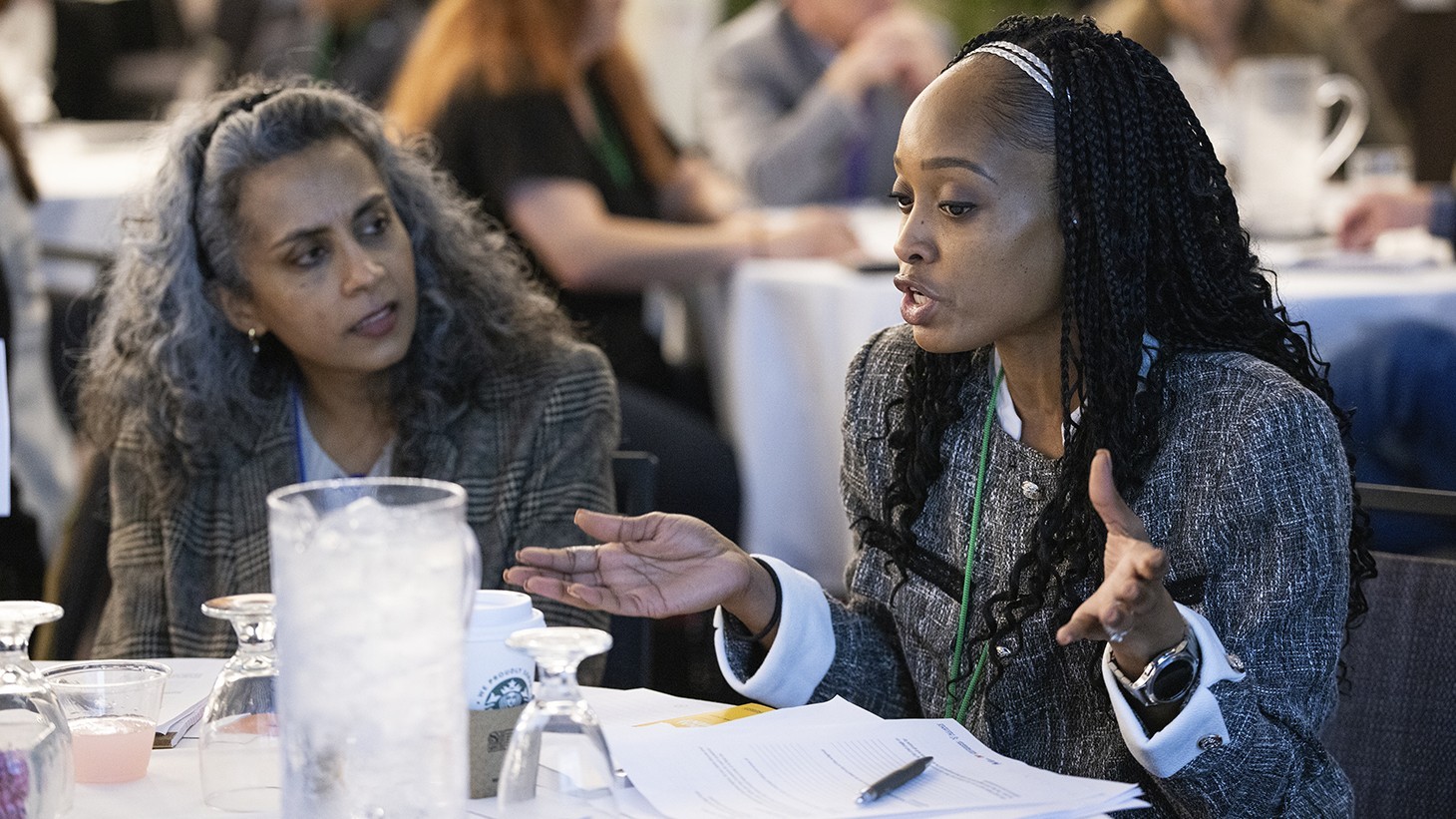
Kaiser Permanente and the Alliance of Health Care Unions kicked off national bargaining May 6 to 8 in Los Angeles. Bargaining sessions are scheduled through the summer.
Optimism marks start of national contract talks
On May 6, Kaiser Permanente and the Alliance of Health Care Unions kicked off negotiations for a new national agreement.
Labor Management Partnership chairs Arlene Peasnall, Jim Pruitt, and Hal Ruddick opened the 3-day session. They emphasized partnership, trust-building, and addressing health care challenges together.
Labor and management representatives sat together as they learned about interest-based negotiations. These negotiations focus on each party’s interests, needs and concerns to develop mutually beneficial solutions. The approach is foundational to the Labor Management Partnership.
Bargaining team members also presented partnership successes and challenges related to unit-based teams, affordability, and career development. The goal was to show that working together can lead to solutions for important issues and advancements for employees and patients and members. They also made clear that there is still work to do in these key areas.
The Alliance National Agreement expires September 30, 2025.
Bargaining sessions are scheduled through the summer, with the goal of reaching a new agreement before the contract expires.
Labor Management Partnership
The Alliance of Health Care Unions is made up of 23 local unions. They represent about 61,000 nurses, medical assistants, lab technicians, environmental services workers, engineers, pharmacists, therapists, and other health care professionals.
KP and the Alliance are part of the Labor Management Partnership, the largest and longest-running partnership of its kind in the United States.
The partnership brings together employees, managers, and physicians to identify opportunities to improve service, quality, affordability, and the quality of the work environment.
Common Issues Committee
The national bargaining team is known as the Common Issues Committee. A new Common Issues Committee is formed each bargaining year, comprised of management and labor representatives.
KP and Alliance leaders select members and assign each to a subgroup to address a topic area. For 2025, those topics are:
- AI (artificial intelligence) and technology
- Labor-management partnership effectiveness
- Staffing and patient care
Subgroups
A manager and an Alliance union representative lead each subgroup. (One subgroup has more than one pair of co-leads).
Subgroup members work to understand each other’s interests and find creative ways to address key topics or solve problems.
During the May session, subgroups began their work.
The AI subgroup heard from subject matter experts who shared their perspectives about how artificial intelligence might be applied to health care settings.
The Staffing and Patient Care subgroup reviewed their deliverables, discussed the best way to tackle their work together, and formed small groups to address specific issues.
And the Partnership Effectiveness subgroup divided into 3 teams, each to consider a key focus area: unit-based teams, Labor Management Partnership training, and just culture, an operational strategy that promotes continuous learning and performance improvement.
Over the course of bargaining, each subgroup will bring its proposals to the Common Issues Committee for discussion and agreement. The Common Issues Committee will also reach agreement on wages, benefits, and other economic issues. The finalized contract then goes to KP management for approval and is ratified by the members of each local union in the Alliance.
The next national bargaining session is scheduled for June 3 to 5, 2025.